
How in tune is your organization?
Most asset-intensive organizations share a familiar structure. Maintenance runs on one system, reliability engineering on another, capital planning sits in finance, and scheduling is handled wherever there is capacity for it. Each discipline is staffed by capable people doing good work, but each developed independently, with separate systems, metrics, and incentives.
That separation carries real costs. Deferred maintenance becomes an interdepartmental dispute rather than a managed decision. Capital plans are built without a live connection to asset condition, so the assets that need funding and the assets that receive it are not always the same. Official schedules coexist with the informal versions crews actually follow. The cause is rarely poor tools or poor intent; it is that the disciplines were never aligned with one another.
The idea behind the Resonance Score
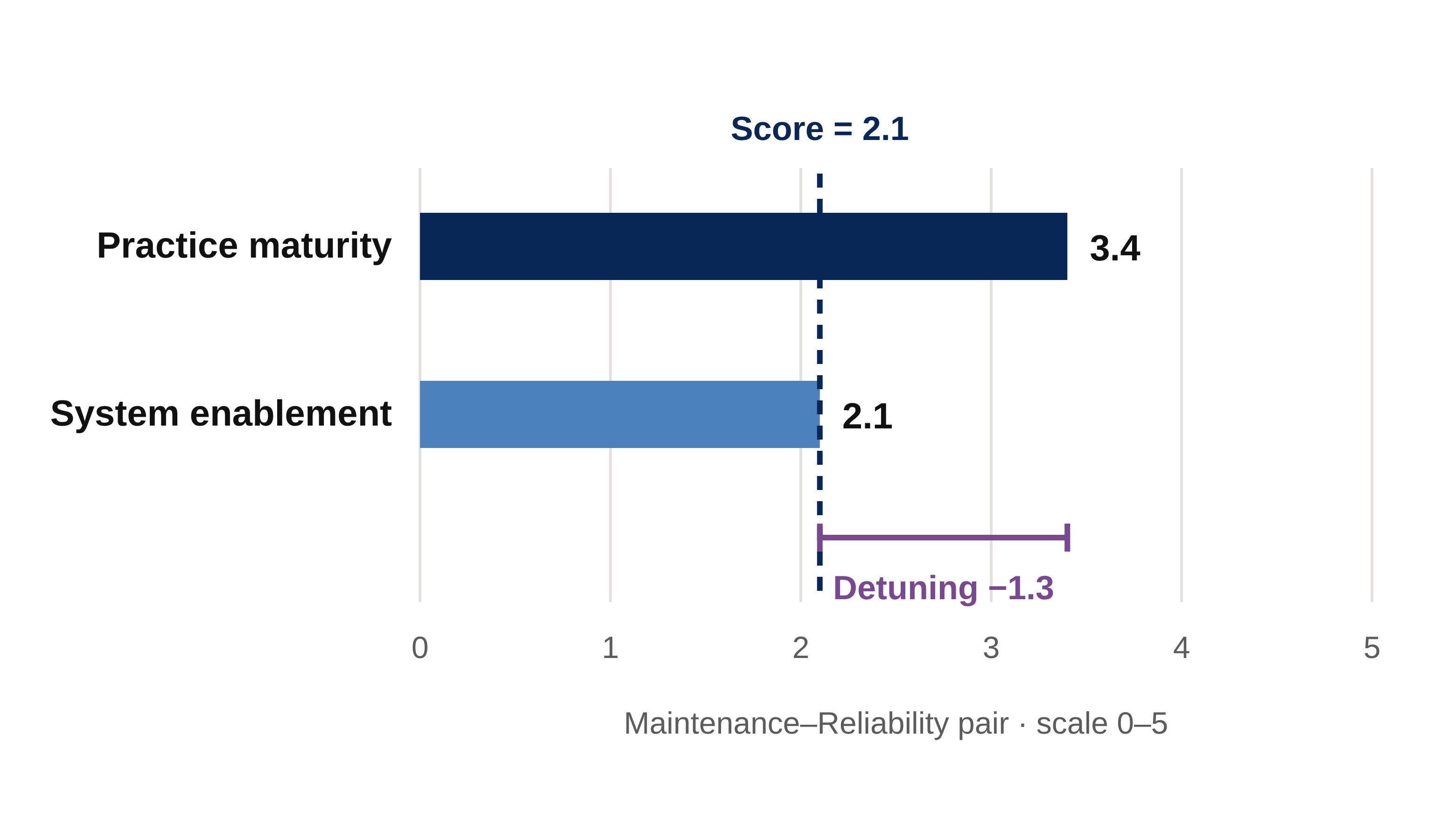
Our view is that alignment between disciplines should be measured rather than assumed. For each critical pair of disciplines, the Resonance Score measures two dimensions. Practice maturity covers the habits, skills, and processes on the human side. System enablement covers whether the software the organization already owns is configured to support that work.
The lower of the two numbers becomes the score, because the weaker dimension limits what the pair can deliver. The gap between the two, which we call the Detuning, indicates where to focus. If practice maturity exceeds system enablement, the systems are constraining capable people. If system enablement exceeds practice maturity, the organization has purchased capability it has not yet learned to use.
What maintenance does, and what reliability does
The first pair we assess is maintenance and reliability, terms many organizations use interchangeably despite their distinct roles.
Maintenance is responsible for keeping equipment running now. It executes work orders and the PM program, restores function after failures, and plans, schedules, and kits the work. Its performance measures are response time, schedule compliance, and backlog, and its planning horizon is the current week. Its central question is how the work gets done.
Reliability is responsible for reducing the likelihood of future failure. It analyzes failure history for patterns and root causes, ranks assets by the consequence of their failure, designs PM tasks around how equipment actually fails, and sets the condition thresholds that trigger work before a breakdown occurs. Its performance measures are failure frequency and the share of work that is reactive. Its central question is why equipment fails and what would prevent it.
The two disciplines share assets, budget, and an EAM system, and each depends on the other's output. The strength of that dependency determines how much value the organization realizes from both.
In resonance, and out of it
When the pair is aligned, a productive cycle operates. Daily maintenance work records what failed and why. Reliability converts that history into analysis, and the analysis updates PM tasks, priorities, and condition thresholds. The resulting workload is smaller and better targeted, which frees maintenance capacity and improves the quality of the data feeding the next cycle.
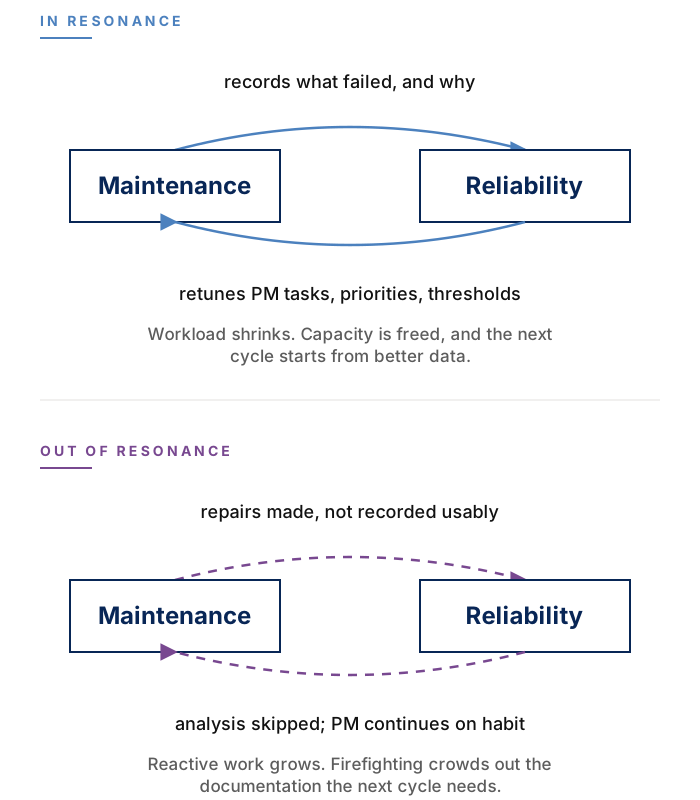
When the pair is misaligned, the cycle works against the organization. Failures are repaired but not recorded in a usable form. Analysis is skipped, or rebuilt manually in spreadsheets. The PM program continues on habit while reactive work grows, and the resulting firefighting leaves even less time for documentation, which further degrades the data.
The costs of this pattern are widely recognized even where the underlying cycle has never been examined. PM effort is spent on low-value tasks while higher-value tasks are omitted. Failures that gave advance warning still run to failure. Spares are stocked by habit, producing stock-outs on the items that matter most. Meanwhile, the reliability tools included in the EAM remain configured but unused. Both teams can perform their individual roles well while these costs persist, because the losses occur in the interaction between the disciplines rather than within either one.
Where we are starting
Our first offering is the Maintenance–Reliability Resonance Score. We chose this pair because the gap between the two disciplines is among the oldest in the field, and because the cycle between them largely determines whether an organization's reliability investment produces a return.
The score is delivered through a structured working session with your team. No new software is required, and no system replacement is assumed. The engagement begins with a candid assessment of where the discipline pair stands today.
What comes next
Additional scores are planned for the discipline pairs where misalignment is most costly: finance and asset management, operations and asset management, and planning and scheduling. Together, these will build toward a composite measure of organizational resonance and a complete picture of how well the organization's disciplines work together.
If you would like to know where your organization stands, we would welcome the opportunity to score a discipline pair with you. The process requires a single working session and produces a result you can act on.